

generally, which element of film generally draws the audience to the movies?
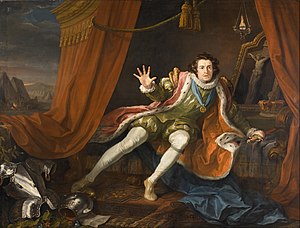
An histrion or actress (see below) is a person who portrays a graphic symbol in a performance.[1] The actor performs "in the flesh" in the traditional medium of the theatre or in modernistic media such equally moving picture, radio, and telly. The analogous Greek term is ὑποκριτής ( hupokritḗs ), literally "one who answers".[ii] The thespian'south interpretation of a part—the fine art of acting—pertains to the role played, whether based on a existent person or fictional character. This tin can also be considered an "actor's office," which was called this due to scrolls beingness used in the theaters. Estimation occurs fifty-fifty when the actor is "playing themselves", as in some forms of experimental performance art.
Formerly, in aboriginal Greece and the medieval world, and in England at the fourth dimension of William Shakespeare, only men could get actors, and women'due south roles were generally played by men or boys.[3] While Ancient Rome did allow female stage performers, only a modest minority of them were given speaking parts. The commedia dell'arte of Italy, however, immune professional women to perform early on on; Lucrezia Di Siena, whose name is on a contract of actors from 10 Oct 1564, has been referred to equally the first Italian actress known by name, with Vincenza Armani and Barbara Flaminia as the starting time primadonnas and the starting time well-documented actresses in Italian republic (and in Europe).[4] Later on the English Restoration of 1660, women began to appear onstage in England. In modern times, specially in pantomime and some operas, women occasionally play the roles of boys or immature men.[5]
History [edit]
The first recorded case of a performing thespian occurred in 534 BC (though the changes in calendar over the years make it hard to determine exactly) when the Greek performer Thespis stepped onto the stage at the Theatre Dionysus to go the first known person to speak words as a character in a play or story. Before Thespis' act, Grecian stories were only expressed in song, trip the light fantastic, and in third person narrative. In honor of Thespis, actors are commonly called Thespians. The exclusively male actors in the theatre of aboriginal Greece performed in three types of drama: tragedy, comedy, and the satyr play.[6] Western theatre developed and expanded considerably under the Romans. The theatre of ancient Rome was a thriving and various art form, ranging from festival performances of street theatre, nude dancing, and acrobatics, to the staging of situation comedies, to high-manner, verbally elaborate tragedies.
As the Western Roman Empire fell into decay through the 4th and fifth centuries, the seat of Roman power shifted to Constantinople and the Byzantine Empire. Records show that mime, pantomime, scenes or recitations from tragedies and comedies, dances, and other entertainments were very pop. From the fifth century, Western Europe was plunged into a menstruation of general disorder. Small nomadic bands of actors traveled around Europe throughout the menstruation, performing wherever they could notice an audition; there is no prove that they produced anything just rough scenes.[seven] Traditionally, actors were not of loftier status; therefore, in the Early on Middle Ages, traveling acting troupes were often viewed with distrust. Early Middle Ages actors were denounced past the Church during the Dark Ages, as they were viewed as dangerous, immoral, and pagan. In many parts of Europe, traditional beliefs of the region and fourth dimension meant actors could not receive a Christian burial.
In the Early Middle Ages, churches in Europe began staging dramatized versions of biblical events. By the centre of the 11th century, liturgical drama had spread from Russia to Scandinavia to Italy. The Feast of Fools encouraged the evolution of comedy. In the Late Middle Ages, plays were produced in 127 towns. These vernacular Mystery plays ofttimes contained comedy, with actors playing devils, villains, and clowns.[eight] The majority of actors in these plays were drawn from the local population. Apprentice performers in England were exclusively male, but other countries had female performers.
In that location were several secular plays staged in the Heart Ages, the primeval of which is The Play of the Greenwood by Adam de la Halle in 1276. It contains satirical scenes and folk material such as faeries and other supernatural occurrences. Farces also rose dramatically in popularity later on the 13th century. At the stop of the Late Middle Ages, professional actors began to appear in England and Europe. Richard III and Henry Seven both maintained small companies of professional actors. Beginning in the mid-16th century, Commedia dell'arte troupes performed lively improvisational playlets across Europe for centuries. Commedia dell'arte was an histrion-centred theatre, requiring petty scenery and very few props. Plays were loose frameworks that provided situations, complications, and outcome of the action, around which the actors improvised. The plays used stock characters. A troupe typically consisted of 13 to 14 members. Most actors were paid a share of the play'due south profits roughly equivalent to the sizes of their roles.
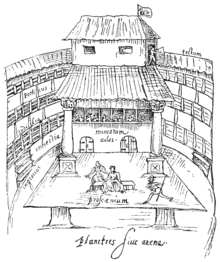
Renaissance theatre derived from several medieval theatre traditions, such as the mystery plays, "morality plays", and the "university drama" that attempted to recreate Athenian tragedy. The Italian tradition of Commedia dell'arte, likewise as the elaborate masques frequently presented at court, besides contributed to the shaping of public theatre. Since before the reign of Elizabeth I, companies of players were attached to households of leading aristocrats and performed seasonally in diverse locations. These became the foundation for the professional players that performed on the Elizabethan stage.
The development of the theatre and opportunities for acting ceased when Puritan opposition to the phase banned the performance of all plays inside London. Puritans viewed the theatre as immoral. The re-opening of the theatres in 1660 signaled a renaissance of English drama. English comedies written and performed in the Restoration menstruum from 1660 to 1710 are collectively called "Restoration comedy". Restoration comedy is notorious for its sexual explicitness. At this point, women were allowed for the first fourth dimension to appear on the English phase, exclusively in female roles. This period saw the introduction of the first professional actresses and the rising of the first celebrity actors.
19th century [edit]
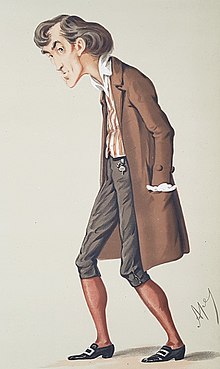
In the 19th century, the negative reputation of actors was largely reversed, and acting became an honored, popular profession and art.[9] The rise of the role player as celebrity provided the transition, as audiences flocked to their favorite "stars". A new function emerged for the thespian-managers, who formed their own companies and controlled the actors, the productions, and the financing.[x] When successful, they built up a permanent clientele that flocked to their productions. They could enlarge their audition by going on tour beyond the land, performing a repertoire of well-known plays, such as those past Shakespeare. The newspapers, private clubs, pubs, and java shops rang with lively debates evaluating the relative merits of the stars and the productions. Henry Irving (1838-1905) was the most successful of the British player-managers.[eleven] Irving was renowned for his Shakespearean roles, and for such innovations as turning out the firm lights so that attention could focus more on the stage and less on the audition. His company toured across U.k., besides as Europe and the United States, demonstrating the power of star actors and celebrated roles to attract enthusiastic audiences. His knighthood in 1895 indicated full acceptance into the higher circles of British society.[12]
20th century [edit]

By the early 20th century, the economics of big-scale productions displaced the actor-manager model. It was too hard to find people who combined a genius at interim as well as management, and then specialization divided the roles as stage managers and later theatre directors emerged. Financially, much larger capital was required to operate out of a major metropolis. The solution was corporate ownership of chains of theatres, such as by the Theatrical Syndicate, Edward Laurillard, and especially The Shubert Organisation. By catering to tourists, theaters in large cities increasingly favored long runs of highly pop plays, specially musicals. Big name stars became even more essential.[xiii]
Techniques [edit]
- Classical acting is a philosophy of acting that integrates the expression of the body, phonation, imagination, personalizing, improvisation, external stimuli, and script analysis. It is based on the theories and systems of select classical actors and directors including Konstantin Stanislavski and Michel Saint-Denis.
- In Stanislavski's organization, also known as Stanislavski's method, actors draw upon their own feelings and experiences to convey the "truth" of the grapheme they portray. Actors puts themselves in the mindset of the character, finding things in mutual to requite a more than genuine portrayal of the character.
- Method acting is a range of techniques based on for training actors to achieve better characterizations of the characters they play, as formulated by Lee Strasberg. Strasberg'due south method is based upon the thought that to develop an emotional and cognitive understanding of their roles, actors should use their own experiences to place personally with their characters. It is based on aspects of Stanislavski's organisation. Other interim techniques are besides based on Stanislavski's ideas, such every bit those of Stella Adler and Sanford Meisner, but these are not considered "method acting".[fourteen]
- Meisner technique requires the role player to focus totally on the other actor every bit though he or she is real and they only exist in that moment. This is a method that makes the actors in the scene seem more than authentic to the audience. It is based on the principle that acting finds its expression in people's response to other people and circumstances. Is it based on Stanislavski's organisation.
As the opposite sex [edit]
Formerly, in some societies, but men could become actors. In ancient Hellenic republic and aboriginal Rome[15] and the medieval world, information technology was considered disgraceful for a woman to go on stage; all the same, women did perform in Ancient Rome, and again entered the stage in the Commedia dell'arte in Italy in the 16th century; Lucrezia Di Siena became the mayhap commencement professional person actress since Ancient Rome. France and Spain, as well, also had female actors in the 16th century. In William Shakespeare's England, even so, women's roles were generally played by men or boys.[three]
When an eighteen-yr Puritan prohibition of drama was lifted subsequently the English Restoration of 1660, women began to appear on stage in England. Margaret Hughes is frequently credited as the first professional person actress on the English language stage.[16] Previously, Angelica Martinelli, a member of a visiting Italian Commedia dell' arte visitor, did perform in England every bit early equally 1578, [17] merely such strange guest appearances had been rare exceptions and there had been no professional English language actresses in England. This prohibition ended during the reign of Charles II in part because he enjoyed watching actresses on stage.[xviii] Specifically, Charles II issued letters patent to Thomas Killigrew and William Davenant, granting them the monopoly right to course two London theatre companies to perform "serious" drama, and the letters patent were reissued in 1662 with revisions allowing actresses to perform for the starting time time.[19]
According to the OED, the beginning occurrence of the term actress was in 1608 and is ascribed to Middleton. In the 19th century, many viewed women in interim negatively, every bit actresses were frequently courtesans and associated with promiscuity. Despite these prejudices, the 19th century besides saw the outset female person interim "stars", most notably Sarah Bernhardt.[20]
In Nippon, onnagata, or men taking on female roles, were used in kabuki theatre when women were banned from performing on stage during the Edo period; this convention continues. In some forms of Chinese drama such as Beijing opera, men traditionally performed all the roles, including female roles, while in Shaoxing opera women often play all roles, including male ones.[21]
In modern times, women occasionally played the roles of boys or young men. For example, the stage function of Peter Pan is traditionally played by a woman, as are most principal boys in British pantomime. Opera has several "breeches roles" traditionally sung by women, usually mezzo-sopranos. Examples are Hansel in Hänsel und Gretel, Cherubino in The Marriage of Figaro and Octavian in Der Rosenkavalier.
Women playing male roles are uncommon in film, with notable exceptions. In 1982, Stina Ekblad played the mysterious Ismael Retzinsky in Fanny and Alexander, and Linda Hunt received the University Award for Best Supporting Actress for playing Billy Kwan in The Yr of Living Dangerously. In 2007, Cate Blanchett was nominated for the University Award for Best Supporting Extra for playing Jude Quinn, a fictionalized representation of Bob Dylan in the 1960s, in I'g Non There.
In the 2000s, women playing men in alive theatre is especially common in presentations of older plays, such equally Shakespearean works with large numbers of male person characters in roles where gender is inconsequential.[5]
Having an actor dress as the opposite sex for comic effect is as well a long-continuing tradition in comic theatre and film. Most of Shakespeare's comedies include instances of overt cross-dressing, such as Francis Flute in A Midsummer Night'southward Dream. The movie A Funny Thing Happened on the Way to the Forum stars Jack Gilford dressing as a young helpmate. Tony Curtis and Jack Lemmon famously posed as women to escape gangsters in the Billy Wilder pic Some Like It Hot. Cantankerous-dressing for comic upshot was a frequently used device in most of the Carry On films. Dustin Hoffman and Robin Williams have each appeared in a hit comedy flick (Tootsie and Mrs. Doubtfire, respectively) in which they played most scenes dressed as a woman.
Occasionally, the issue is further complicated, for case, past a adult female playing a adult female acting as a man—who so pretends to exist a adult female, such equally Julie Andrews in Victor/Victoria, or Gwyneth Paltrow in Shakespeare in Love. In It's Pat: The Motion picture, film-watchers never learn the gender of the androgynous main characters Pat and Chris (played by Julia Sweeney and Dave Foley). Similarly, in the aforementioned instance of The Spousal relationship of Figaro, at that place is a scene in which Cherubino (a male character portrayed past a woman) dresses up and acts like a adult female; the other characters in the scene are aware of a single level of gender role obfuscation, while the audition is aware of ii levels.
A few mod roles are played by a fellow member of the opposite sex to emphasize the gender fluidity of the role. Edna Turnblad in Hairspray was played by Divine in the 1988 original film, Harvey Fierstein in the Broadway musical, and John Travolta in the 2007 picture musical. Eddie Redmayne was nominated for an Academy Award for playing Lili Elbe (a trans woman) in 2022's The Danish Daughter.[22]
The term extra [edit]

In contrast to Ancient Greek theatre, Aboriginal Roman theatre did allow female performers. While the majority of them were seldom employed in speaking roles but rather for dancing, there was a minority of actresses in Rome employed in speaking roles, and also those who accomplished wealth, fame and recognition for their art, such as Eucharis, Dionysia, Galeria Copiola and Fabia Arete, and they too formed their own interim society, the Sociae Mimae, which was manifestly quite wealthy. [23] The profession seemingly died out in tardily antiquity.
While women did not brainstorm to perform onstage in England until the second half of the 17th-century, they did appear in Italian republic, Espana and France from the tardily 16th-century onward. Lucrezia Di Siena, whose proper name is on an acting contract in Rome from 10 October 1564, has been referred to every bit the showtime Italian actress known past name, with Vincenza Armani and Barbara Flaminia as the kickoff primadonnas and the outset well documented actresses in Italy (and Europe). [4]
Afterwards 1660 in England, when women showtime started to appear on stage, the terms role player or actress were initially used interchangeably for female performers, but later, influenced past the French actrice, actress became the commonly used term for women in theater and film. The etymology is a simple derivation from histrion with -ess added.[24] When referring to groups of performers of both sexes, actors is preferred.[25]
Within the profession, the re-adoption of the neutral term dates to the post-war menstruation of the 1950 and '60s, when the contributions of women to cultural life in general were being reviewed.[26] When The Observer and The Guardian published their new joint style guide in 2022, information technology stated "Utilize ['role player'] for both male and female actors; do not use actress except when in name of honour, e.thousand. Oscar for all-time extra".[25] The guide's authors stated that "actress comes into the same category as authoress, comedienne, manageress, 'lady physician', 'male nurse' and like obsolete terms that date from a time when professions were largely the preserve of one sex (usually men)." (See male person equally norm.) "As Whoopi Goldberg put it in an interview with the paper: 'An actress can only play a woman. I'm an actor – I tin can play annihilation.'"[25] The UK performers' union Equity has no policy on the utilise of "histrion" or "actress". An Disinterestedness spokesperson said that the marriage does not believe that there is a consensus on the affair and stated that the "...subject divides the profession".[25] In 2009, the Los Angeles Times stated that "Actress" remains the common term used in major acting awards given to female recipients[27] (e.g., University Award for Best Actress).
With regard to the cinema of the U.s.a., the gender-neutral term "player" was common in flick in the silent motion-picture show era and the early days of the Motion Motion picture Production Code, but in the 2000s in a film context, it is by and large accounted archaic.[ commendation needed ] Yet, "histrion" remains in use in the theatre, oft incorporated into the name of a theatre group or company, such as the American Players, the East West Players, etc. Also, actors in improvisational theatre may exist referred to as "players".[28]

Pay equity [edit]
In 2022, Forbes reported that "...but 21 of the 100 superlative-grossing films of 2022 featured a female lead or co-lead, while simply 28.i% of characters in 100 top-grossing films were female...".[29] "In the U.S., in that location is an "industry-wide [gap] in salaries of all scales. On average, white women earn 78 cents to every dollar a white human makes, while Hispanic women earn 56 cents to a white male person's dollar, blackness women 64 cents and Native American women just 59 cents to that."[29] Forbes' analysis of United states interim salaries in 2022 determined that the "...men on Forbes' listing of top-paid actors for that year made two one / 2 times equally much money as the top-paid actresses. That means that Hollywood'south all-time-compensated actresses made just 40 cents for every dollar that the best-compensated men made."[30] [31] [32]
Types [edit]
Actors working in theatre, film, television, and radio have to acquire specific skills. Techniques that work well in 1 blazon of acting may not piece of work well in another blazon of acting.
In theatre [edit]
To act on stage, actors need to larn the phase directions that appear in the script, such as "Stage Left" and "Phase Right". These directions are based on the thespian's point of view as he or she stands on the stage facing the audience. Actors also accept to larn the meaning of the stage directions "Upstage" (abroad from the audience) and "Downstage" (towards the audience)[33] Theatre actors need to learn blocking, which is "...where and how an actor moves on the stage during a play". Nearly scripts specify some blocking. The Director also gives instructions on blocking, such as crossing the stage or picking up and using a prop.[33]
Some theater actors need to learn stage gainsay, which is simulated fighting on phase. Actors may have to simulate mitt-to-hand fighting or sword-fighting. Actors are coached by fight directors, who aid them learn the choreographed sequence of fight actions.[33]
In film [edit]
Silent films [edit]
From 1894 to the late 1920s, movies were silent films. Silent pic actors emphasized body linguistic communication and facial expression, and so that the audience could better understand what an actor was feeling and portraying on screen. Much silent picture acting is apt to strike modern-day audiences equally simplistic or campy. The melodramatic acting style was in some cases a habit actors transferred from their former stage feel. Vaudeville theatre was an especially popular origin for many American silent film actors.[34] The pervading presence of phase actors in picture was the crusade of this outburst from manager Marshall Neilan in 1917: "The sooner the stage people who have come into pictures get out, the better for the pictures." In other cases, directors such equally John Griffith Wray required their actors to evangelize larger-than-life expressions for emphasis. As early as 1914, American viewers had begun to brand known their preference for greater naturalness on screen.[35]
Pioneering picture directors in Europe and the United States recognized the different limitations and freedoms of the mediums of stage and screen past the early 1910s. Silent films became less vaudevillian in the mid-1910s, as the differences between stage and screen became apparent. Due to the piece of work of directors such as D W Griffith, cinematography became less stage-like, and the so-revolutionary close-up shot allowed subtle and naturalistic acting. In America, D.W. Griffith's company Biograph Studios, became known for its innovative direction and acting, conducted to suit the cinema rather than the stage. Griffith realized that theatrical interim did non expect skilful on movie and required his actors and actresses to get through weeks of movie interim training.[36]
Lillian Gish has been called film's "first true actress" for her piece of work in the period, every bit she pioneered new film performing techniques, recognizing the crucial differences betwixt stage and screen acting. Directors such as Albert Capellani and Maurice Tourneur began to insist on naturalism in their films. Past the mid-1920s many American silent films had adopted a more than naturalistic acting style, though non all actors and directors accepted naturalistic, low-key acting straight away; as late as 1927, films featuring expressionistic interim styles, such as Urban center, were notwithstanding being released.[35]
According to Anton Kaes, a silent motion picture scholar from the Academy of Wisconsin, American silent cinema began to see a shift in acting techniques between 1913 and 1921, influenced past techniques found in German silent picture show. This is mainly attributed to the influx of emigrants from the Weimar Democracy, "including moving-picture show directors, producers, cameramen, lighting and stage technicians, besides as actors and actresses".[37]
The advent of sound in film [edit]
Flick actors have to learn to go used to and be comfortable with a camera beingness in front of them.[38] Moving picture actors need to learn to find and stay on their "mark." This is a position on the floor marked with tape. This position is where the lights and camera focus are optimized. Film actors also need to learn how to ready well and perform well on-screen tests. Screen tests are a filmed audition of part of the script.
Unlike theater actors, who develop characters for repeat performances, motion picture actors lack continuity, forcing them to come to all scenes (sometimes shot in reverse of the social club in which they ultimately appear) with a fully adult character already.[36]
"Since flick captures even the smallest gesture and magnifies it..., cinema demands a less flamboyant and stylized bodily performance from the actor than does the theater." "The performance of emotion is the about hard aspect of picture acting to master: ...the moving picture actor must rely on subtle facial ticks, quivers, and tiny lifts of the eyebrow to create a believable character."[36] Some theatre stars "...have made the theater-to-movie theater transition quite successfully (Laurence Olivier, Glenn Close, and Julie Andrews, for instance), others have not..."[36]
In television [edit]
"On a television set set, there are typically several cameras angled at the set. Actors who are new to on-screen acting tin get confused about which camera to look into."[33] Television receiver actors need to learn to use lav mics (Lavaliere microphones).[33] TV actors demand to empathise the concept of "frame". "The term frame refers to the area that the camera's lens is capturing."[33] Within the acting manufacture, there are four types of television roles one could state on a show. Each blazon varies in prominence, frequency of appearance, and pay. The first is known as a series regular—the main actors on the show as part of the permanent cast. Actors in recurring roles are nether contract to announced in multiple episodes of a serial. A co-star role is a small speaking role that commonly simply appears in one episode. A guest star is a larger office than a co-star role, and the character is often the primal focus of the episode or integral to the plot.
In radio [edit]
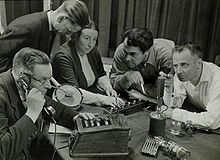
Radio drama is a dramatized, purely acoustic functioning, circulate on radio or published on audio media, such as record or CD. With no visual component, radio drama depends on dialogue, music and sound effects to assist the listener imagine the characters and story: "It is auditory in the concrete dimension but as powerful equally a visual force in the psychological dimension."[39]
Radio drama accomplished widespread popularity within a decade of its initial evolution in the 1920s. Past the 1940s, it was a leading international pop entertainment. With the advent of television in the 1950s, however, radio drama lost some of its popularity, and in some countries has never regained large audiences. However, recordings of OTR (one-time-fourth dimension radio) survive today in the audio archives of collectors and museums, every bit well equally several online sites such as Internet Archive.
As of 2022[update], radio drama has a minimal presence on terrestrial radio in the U.s.a.. Much of American radio drama is restricted to rebroadcasts or podcasts of programs from previous decades. Nevertheless, other nations still have thriving traditions of radio drama. In the United kingdom of great britain and northern ireland, for example, the BBC produces and broadcasts hundreds of new radio plays each twelvemonth on Radio 3, Radio iv, and Radio four Extra. Podcasting has besides offered the means of creating new radio dramas, in addition to the distribution of vintage programs.
The terms "audio drama"[40] or "audio theatre" are sometimes used synonymously with "radio drama" with one possible distinction: audio drama or audio theatre may non necessarily be intended specifically for broadcast on radio. Audio drama, whether newly produced or OTR classics, tin be found on CDs, cassette tapes, podcasts, webcasts, and conventional broadcast radio.
Thank you to advances in digital recording and Internet distribution, radio drama is experiencing a revival.[41]
See too [edit]
- Bit part
- Body double
- Cameo appearance
- Cast member
- Graphic symbol player
- Child role player
- Commedia dell'arte
- Dramatis personæ
- Droll
- Actress (interim)
- Farce
- GOTE
- Kabuki
- Leading actor
- Lists of actors
- Matinee idol
- Meisner technique
- Mime artist
- Pic star
- Music hall
- Pantomime
- Pornographic film role player
- Practical Aesthetics
- Presentational and representational acting
- Supporting actor
- Understudy
- Vaudeville
- Vocalization acting
References [edit]
- ^ "The dramatic world can be extended to include the 'author', the 'audience' and even the 'theatre'; but these remain 'possible' surrogates, not the 'bodily' referents as such" (Elam 1980, 110).
- ^ "Definition of actor". Hypokrites (related to our discussion for hypocrite) as well means, less often, "to respond" the tragic chorus. See Weimann (1978, 2); see also Csapo and Slater, who offer translations of classical source textile using the term hypocrisis (acting) (1994, 257, 265–267).
- ^ a b Neziroski, Lirim (2003). "narrative, lyric, drama". Theories of Media :: Keywords Glossary :: multimedia. Academy of Chicago. Retrieved fourteen March 2009.
For example, until the late 1600s, audiences were opposed to seeing women on phase, because of the belief stage performance reduced them to the status of showgirls and prostitutes. Fifty-fifty Shakespeare'south plays were performed by boys dressed in drag.
- ^ a b Giacomo Oreglia (2002). Commedia dell'arte. Ordfront. ISBN 91-7324-602-6
- ^ a b JULIET DUSINBERRE. "Boys Becoming Women in Shakespeare's Plays" (PDF). S-sj.org\accessdate=22 October 2022.
- ^ Brockett and Hildy (2003, 15–19).
- ^ Brockett and Hildy (2003, 75)
- ^ Brockett and Hildy (2003, 86)
- ^ Wilmeth, Don B.; Bigsby, C.West.Due east. (1998). The Cambridge history of American theatre . Cambridge, Great britain: Cambridge University Press. pp. 449–450. ISBN978-0-521-65179-0.
- ^ James Eli Adams, ed., Encyclopedia of the Victorian era (2004) 1:2-3.
- ^ George Rowell, Theatre in the Historic period of Irving (Rowman & Littlefield, 1981).
- ^ Jeffrey Richards (2007). Sir Henry Irving: A Victorian Actor and His World. A&C Black. p. 109. ISBN9781852855918.
- ^ Foster Hirsch, The Boys from Syracuse: The Shuberts' Theatrical Empire (Cooper Foursquare Printing, 2000).
- ^ Guerrasio, Jason. (19 Dec 2022) What Information technology Ways To Be 'Method' Archived 2022-06-23 at the Wayback Motorcar. Tribecafilminstitute.org. Retrieved on 2022-02-10.
- ^ "BBC - Radio 4 - Adult female's 60 minutes -Women Actors in Ancient Rome". Bbc.co.uk . Retrieved 22 October 2022.
- ^ "Smallweed". The Guardian. 23 July 2005. Archived from the original on 22 April 2009.
"Whereas women's parts in plays accept hitherto been acted by men in the habits of women ... we do permit and give leave for the fourth dimension to come that all women's parts be acted by women," Charles Ii ordained in 1662. According to Brewer'due south Lexicon of Phrase and Legend, the get-go actress to exploit this new freedom was Margaret Hughes, as Desdemona in Othello on December eight, 1660.
- ^ K.A. Katritzky: Women, Medicine and Theatre 1500–1750: Literary Mountebanks and Performing
- ^ "Women as actresses" (PDF). Notes and Queries. The New York Times. 18 October 1885. Archived (PDF) from the original on 11 May 2022. Retrieved 14 March 2009.
There seems no doubt that actresses did not perform on the stage till the Restoration, in the primeval years of which Pepys says for the offset fourth dimension he saw an actress upon the stage. Charles Two, must take brought the usage from the Continent, where women had long been employed instead of boys or youths in the representation of female characters.
- ^ Fisk, Deborah Payne (2001). "The Restoration Actress". In Owen, Susan J. A companion to restoration drama, pg. 73, (one. publ. ed.). Oxford [u.a.]: Blackwell. ISBN 978-0631219231.
- ^ 'Studies in hysteria': extra and courtesan, Sarah Bernhardt and Mrs Patrick Campbell
- ^ Richard Gunde, Culture and Community of People's republic of china (2002), page 63.
- ^ Andrea Mandell, Can Eddie Redmayne nab Oscar No. ii?, xx December 2022, USA Today
- ^ Pat Easterling, Edith Hall: Greek and Roman Actors: Aspects of an Ancient Profession
- ^ "actress, n.". Oxford English Lexicon (3 ed.). Oxford, England: Oxford University Press. Nov 2022.
Although histrion refers to a person who acts regardless of gender, where this term "is increasingly preferred", actress remains in general use; actor is increasingly preferred for performers of both sexes equally a gender-neutral term.
- ^ a b c d Pritchard, Stephen (24 September 2022). "The readers' editor on... Role player or actress?". Theguardian.com . Retrieved 22 Oct 2022.
- ^ Goodman, Lizbeth; Holledge, Julie (1998). The Routledge reader in gender and operation . New York: Routledge. p. 8. ISBN0-415-16583-0.
- ^ Linden, Sheri (xviii January 2009). "From actor to actress and back once again". Entertainment. Los Angeles Times. Retrieved 14 March 2009.
Information technology would be several decades before the word "actress" appeared – 1700, according to the Oxford English Dictionary, more than a century after the word "actor" was first used to denote a theatrical performer, supplanting the less professional-sounding "player."
- ^ Spolin, Viola (1999). Improvisation for the Theater: A Handbook of Teaching and Directing Techniques (3rd ed.). Evanston, Sick: Northwestern Univ Press. pp. Introduction to the 3rd Edition. ISBN0810140004. OCLC 41176682.
- ^ a b Jennifer Lawrence Speaks Out On Making Less Than Male Co-Stars. Forbes.com (13 October 2022). Retrieved on 2022-02-ten.
- ^ Woodruff, Betsy. (23 February 2022) Gender wage gap in Hollywood: It'south very, very wide. Slate.com. Retrieved on 2022-02-10.
- ^ "How much do Hollywood campaigns for an Oscar toll?". Stephenfollows.com. 12 January 2022. Retrieved 2 May 2022.
- ^ Female Movie Stars Experience Earnings Plunge After Age 34. Diverseness (7 February 2022). Retrieved on 2022-02-10.
- ^ a b c d e f "Industry Tips". Archived from the original on 26 March 2022. Retrieved four April 2022.
- ^ Lewis, John (2008). American Film: A History (First ed.). New York, NY: Due west. Westward. Norton & Company. ISBN978-0-393-97922-0.
- ^ a b Brownlow, Kevin (1968). "Acting". The Parade'south Gone By. University of California Press. pp. 344–353. ISBN9780520030688.
- ^ a b c d "Movies and Picture". infoplease.com.
- ^ Kaes, Anton (1990). "Silent Cinema". Monatshefte.
- ^ "Auditions for Motion-picture show: Moving-picture show Acting Tips and Techniques". Ace-your-audition.com . Retrieved 22 October 2022.
- ^ Tim Crook: Radio drama. Theory and exercise Archived one July 2022 at the Wayback Auto. London; New York: Routledge, 1999, p. eight.
- ^ Compare the entry to Hörspiel e.g. in: dict.cc – Deutsch-Englisch-Wörterbuch
- ^ Newman, Barry (25 February 2022). "Render With U.s. to the Thrilling Days Of Yesteryear — Via the Internet". Wall Street Periodical.
Sources [edit]
- Csapo, Eric, and William J. Slater. 1994. The Context of Ancient Drama. Ann Arbor: The U of Michigan P. ISBN 0-472-08275-2.
- Elam, Keir. 1980. The Semiotics of Theatre and Drama. New Accents Ser. London and New York: Methuen. ISBN 0-416-72060-9.
- Weimann, Robert. 1978. Shakespeare and the Popular Tradition in the Theater: Studies in the Social Dimension of Dramatic Form and Function. Ed. Robert Schwartz. Baltimore and London: The Johns Hopkins Academy Printing. ISBN 0-8018-3506-2.
Further reading [edit]
- An Actor's Work by Constantin Stanislavski
- A Dream of Passion: The Evolution of the Method past Lee Strasberg (Feather Books, ISBN 0-452-26198-eight, 1990)
- Sanford Meisner on Acting past Sanford Meisner (Vintage, ISBN 0-394-75059-4, 1987)
- Letters to a Young Player past Robert Brustein (Basic Books, ISBN 0-465-00806-2, 2005)
- The Empty Infinite by Peter Brook (1st ed by Atheneum, ISBN 0-689-70558-i, 1968)
- The Technique of Acting by Stella Adler (Bantam Books, ISBN 0-553-05299-3, 1988)
External links [edit]
- Screen Actors Lodge (SAG): a union representing U. S. film and Telly actors.
- Actors' Equity Clan (AEA): a wedlock representing U. S. theatre actors and stage managers.
- American Federation of Television and Radio Artists (AFTRA): a matrimony representing U. S. boob tube and radio actors and broadcasters (on-air journalists, etc.).
- British Actors' Equity: a merchandise marriage representing Great britain artists, including actors, singers, dancers, choreographers, stage managers, theatre directors and designers, variety and circus artists, television receiver and radio presenters, walk-on and supporting artists, stunt performers and directors and theatre fight directors.
- Media Entertainment & Arts Alliance: an Australian/New Zealand merchandise union representing everyone in the media, amusement, sports, and arts industries.

Source: https://en.wikipedia.org/wiki/Actor
Posted by: raygozaegesecun46.blogspot.com
0 Response to "generally, which element of film generally draws the audience to the movies?"
Post a Comment